Disk Hernia
Disk Hernia

The dog’s back, just like humans, made up of vertebral bodies opposite to each other. Between each vertebra is a shock-absorbing cartilage disc. This cartilage disc is called disk. A herniated disc, the cartilage disc either pushed upwards and into the vertebral canal, where the spinal cord is or has ruptured and leaked a gelatinous or sometimes calcified, harder mass into the vertebral canal.
The vertebral canal is the dog’s spinal cord. When a dog is suffering from a herniated disc, press the counter mass in the spinal cord and its membranes. Damaged spinal cord so this leads to disability in the back part of the body or all four legs depending on where the herniated disc sits. It can also occur around and bleeding in the spinal cord that can cause swelling and tissue death.
Symptoms
Symptoms range from pain to total paralysis, depending on how extensive the damage is and where it sits. Herniated discs are most common between the vertebrae in the boundary between the chest and lumbar (over the last three ribs), but sometimes even suffer neck vertebrae. Then the symptoms usually sharp pain and occasionally a limp or reduced mobility in one or both front legs. In
a severe neck herniated disc, the animal may become lame on all four legs.
Herniated discs can be roughly divided into the following degrees: 1. Pain from the back, but no evidence of impaired nerve function.
2. The dog has impaired motor skills, paralysis, but can go.
3. Can not move, paralyzed (paralysis), while retaining the deep pain sensitivity, which means that the dog will react if one pinches greatly in the skin.
4. Completely paralyzed, no deep pain sensation.
Diagnostics
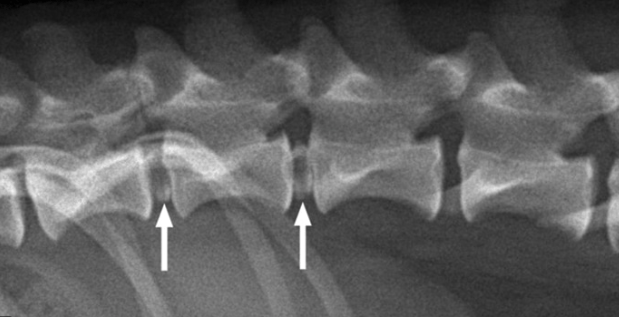
Most herniated disc is not visible on an x-ray image, then the discs made up of cartilage. In some cases, destroyed degenerated discs become calcified and when they show up even on regular x-ray. In order to set accurate diagnosis is needed, however, usually a contrast radiography, myelography.
When the contrast agent is injected into the vertebral canal to see where the stricture is located, today, there are even more advanced imaging with magnetic resonance imaging (MRI) or computed tomography (CT). There they have a greater opportunity to see more accurately the change was seated and also changes outside the vertebral canal is visible.
Treatment
Conservative treatment generally works better for the dogs that come into the group of 1-2 symptoms than those in groups 3-4.
The treatment is based on strict rest, the dog will not even move indoors, but should be in a cage or linked and should be carried downstairs during the first weeks. Pain and inflammation are treated with medication and then it is particularly important that the dog does not get movement when it starts to feel better.
For dogs in the group 1-2 is done in most cases great improvement within 2-8 weeks. If improvement does not occur, you can re-evaluate and consider surgery. Surgery is often needed to be done urgently dogs whose symptoms are in category 3-4. The operation should be performed as soon as possible after the injury to achieve the best results, preferably within 8-48 hours. This is especially true when the dog lacks deep pain sensitivity due. larger herniated disc pinches the spinal cord.
In dogs, symptoms in group 1 and 2, surgery may be an option if the dog does not respond to medical treatment or have relapsed symptoms. When surgery is not as acute, but may be scheduled. At surgery herniated disc opens vertebral canal up to access the delete disk mass is pressed out and make room for the spinal cord. Surgery, however, is not risk-free. The spinal cord is a very sensitive area and the surgery itself can cause symptoms worsen due. bleeding, swelling, and new trauma to the spinal cord.
Sometimes the spinal cord also received such severe harm of the herniated disc that feature can never return even if everything goes well with the surgery.
After a herniated disc surgery, where the dog is paralyzed before, often requires a long rehabilitation period. During this time, the dog can be very difficult to walk, it can also be incontinent and need help to empty your bladder first time. Physical therapy is necessary to implement and then the dog may have trouble turning itself must remain vigilant so it does not get bedsores and other complications. Generally, however, the prognosis is good for recovery, even if it takes time.